logo

How to Choose the Best Terrace Awning from China?

Choosing the right Terrace Awning from China requires more than comparing prices and attractive catalog photos. The best decision begins with your building, climate, and daily outdoor habits. Measure the wall width, projection, mounting height, and available clearance carefully. A small measurement error can create expensive installation problems.

Experienced buyers also examine fabric quality, frame strength, motor performance, and drainage design. Acrylic fabric usually offers strong color retention and UV resistance. Powder-coated aluminum can reduce corrosion in humid environments. For windy locations, cassette protection and reliable brackets deserve close attention. Ask suppliers for fabric specifications, load information, product drawings, and installation guidance. Factory photographs help, but independent inspection provides stronger evidence. Samples can reveal stitching, surface finish, and color accuracy before production begins.

Supplier evaluation matters just as much as product selection. Review manufacturing experience, export history, warranty terms, replacement-part availability, and communication speed. A trustworthy manufacturer explains limitations instead of promising impossible performance. Request a complete quotation, including packaging, delivery, accessories, and installation support. Confirm whether the awning has been tested for the conditions expected at your property. No checklist is perfect. Even careful buyers sometimes overlook local wind exposure or maintenance access. A thoughtful choice balances appearance, durability, operating convenience, and long-term support. This guide explains how to compare Chinese manufacturers with greater confidence and fewer costly surprises.

How to Choose the Best Terrace Awning from China?

Terrace Awning Types and Their Main Features

How to Choose the Best Terrace Awning from China?

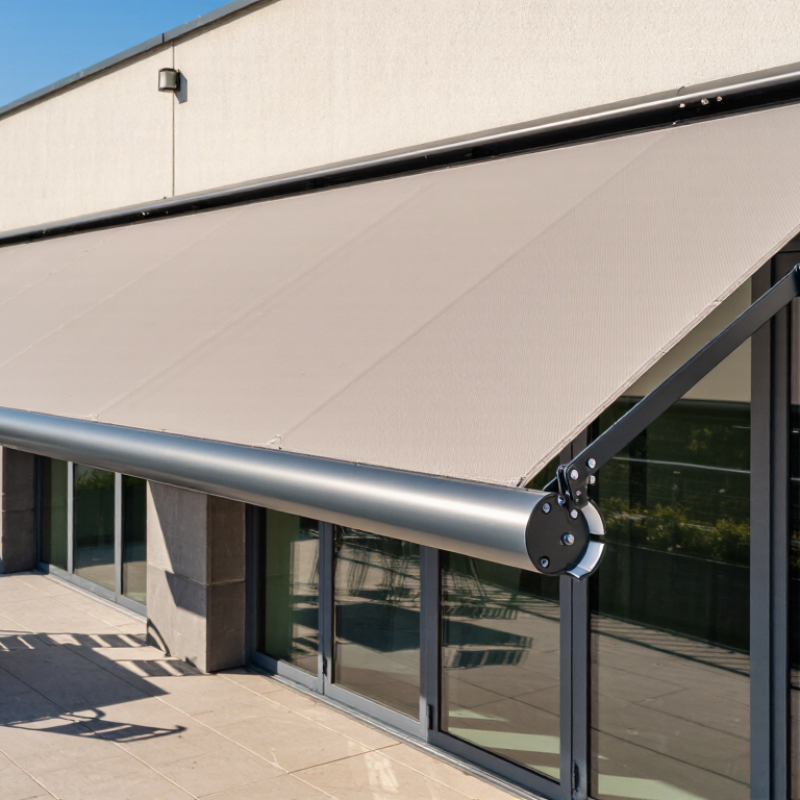
Terrace awnings differ in structure, protection, and daily convenience. Retractable folding-arm awnings suit open balconies and patios. Their arms extend outward, while the fabric rolls into a compact tube. Cassette models protect the rolled fabric from rain, dust, and sunlight. They usually need better installation accuracy. Pergola awnings use posts, tracks, and stronger roof fabrics. They fit larger terraces but require reliable drainage and anchoring. Drop-screen awnings reduce low-angle sunlight and wind exposure. They offer privacy, though their side coverage remains limited.

Material selection needs practical attention. Powder-coated aluminum resists corrosion and keeps the frame relatively light. Solution-dyed acrylic fabric generally provides stronger color stability than ordinary polyester. Check fabric weight, ultraviolet resistance, water repellency, and seam quality. The U.S. Department of Energy reports that window awnings can reduce summer solar heat gain by about 65% to 77% on south-facing windows. This figure depends on orientation, fabric, and local climate. It is not a promise for every terrace.

Market evidence also supports careful specification. Grand View Research estimated the global awnings market at roughly 9 billion U.S. dollars in 2023. Buyers sourcing from China should request wind-load calculations, fabric test reports, corrosion testing, and installation drawings. A motorized system is convenient, but manual operation can be more dependable during power interruptions. I would not select a cheaper frame without checking wall strength. One overlooked anchor can ruin an otherwise excellent awning. Mistakes happen. Supplier communication, sample approval, and pre-shipment inspection still matter.

Key Factors for Comparing Chinese Terrace Awning Suppliers

How to Choose the Best Terrace Awning from China?

Comparing Chinese terrace awning suppliers requires more than checking the lowest quotation. Request clear drawings, aluminum profiles, fabric specifications, and motor details. A reliable supplier should explain wind-load assumptions, drainage design, and suitable installation surfaces. Ask for recent production photos, not only polished showroom images.

Factory experience matters. Review completed projects with similar sizes, climates, and mounting conditions. A small terrace and a twelve-meter outdoor dining area need different structural planning. Check whether the supplier performs profile cutting, coating, assembly, and quality inspections in-house. Sample testing can reveal uneven fabric tension, rough coating edges, or noisy movement. These details are easy to miss online.

Communication is another practical test. Send one detailed specification sheet and compare the accuracy of each reply. Confirm lead times, packaging protection, spare parts, installation guidance, and warranty responsibilities in writing. A low price may hide weak after-sales support. I have seen attractive quotations change after custom packaging and reinforced posts were added. That does not always indicate dishonesty, but it deserves careful questioning. No comparison is perfect. Weather data, installer skill, and site measurements can still create unexpected problems. Request a pre-production confirmation and inspect critical dimensions before shipment. Reliable suppliers accept reasonable corrections instead of rushing approval.

How to Choose the Best Terrace Awning from China?

Key factors for comparing Chinese terrace awning suppliers

The chart uses a practical 100-point evaluation model for comparing terrace awning suppliers. Product quality and weather performance receive the highest weighting, followed by customization, delivery reliability, warranty support, compliance documentation, and total landed cost. Always verify specifications, certifications, samples, and contract terms before placing an order.

How to Evaluate Awning Materials, Design, and Weather Resistance

Choosing a terrace awning from China begins with material evidence, not attractive product photos. Aluminum frames should have consistent wall thickness, clean welds, and corrosion-resistant finishing. Ask for alloy details, coating type, and test reports. Stainless steel fasteners matter near coastal air. Cheap screws can stain and weaken the structure. For fabric, solution-dyed acrylic usually holds color better than ordinary polyester under strong sunlight. However, fabric density, coating, and stitching quality deserve equal attention. Touch the sample. Check the underside.

Design should match the terrace, wall, drainage path, and local wind conditions. Measure the mounting surface carefully, including insulation, brick gaps, and roof overhangs. A neat drawing can reveal problems before production. Retractable systems need smooth joints, balanced arms, and a controlled opening angle. Manual operation may be simpler, while motorized movement adds convenience and more failure points. I have seen attractive awnings fail because brackets were fixed into weak masonry. This is easy to overlook. Request installation drawings, load assumptions, spare-part lists, and clear warranty terms.

Weather resistance requires practical questions. Can the awning withstand gusts, heavy rain, ultraviolet exposure, and repeated opening cycles? Look for water-shedding fabric, sealed seams where appropriate, and a frame finish tested for outdoor use. Ask whether testing reflects your climate, not only a laboratory setting. Drainage should guide water away from doors and walking areas. Snow and ice require special caution; many terrace awnings are not designed to carry them. A supplier that answers precisely is more reliable than one promising “all-weather” performance. Still, specifications are not reality. Inspect samples, verify documents, and allow for local installation mistakes.

How to Choose the Best Terrace Awning from China? - How to Evaluate Awning Materials, Design, and Weather Resistance

Evaluation Dimension Material or Design Option Typical Technical Characteristics Advantages Limitations What to Verify with the Supplier
Awning Fabric Solution-dyed acrylic Pigment is added before the fibers are formed; commonly used for outdoor awnings; good color stability and UV performance. Comfortable appearance, breathable construction, good resistance to sunlight and fading. Usually costs more than standard polyester; may not provide complete waterproofing during prolonged heavy rain. Fiber type, fabric weight, water-repellent treatment, UV test method, colorfastness rating, and warranty terms.
Awning Fabric PVC-coated polyester Polyester base fabric coated with polyvinyl chloride; generally offers a more water-resistant surface. Good resistance to rain, easy cleaning, suitable for applications requiring stronger water protection. Can be heavier and less breathable; surface temperature may rise more in direct sunlight. Coating thickness, hydrostatic water-pressure result, weld or seam quality, mildew resistance, and cold-temperature flexibility.
Awning Fabric Coated polyester Polyester fabric with acrylic, polyurethane, or similar protective coating; performance depends strongly on coating quality. Lightweight, economical, and available in many colors and patterns. Often has lower long-term color and UV durability than higher-grade solution-dyed fabrics. Fabric mass per square meter, coating composition, UV exposure test, tear strength, and expected service environment.
Frame Material Powder-coated aluminum Lightweight metal with natural corrosion resistance; powder coating adds color and surface protection. Low maintenance, good corrosion resistance, and easier installation than heavier steel structures. Lower stiffness than steel of the same size; thin sections may deform under excessive wind load. Aluminum alloy grade, wall thickness, powder-coating thickness, corrosion test, and connection details.
Frame Material Galvanized or powder-coated steel Higher strength and stiffness than aluminum, but protective coatings are essential to limit corrosion. Suitable for larger structures and areas exposed to higher structural loads. Heavier; scratches, cut edges, and unprotected joints can become corrosion points. Steel grade, galvanizing method, coating thickness, weld protection, drainage design, and corrosion test documentation.
Sun Protection High-density outdoor fabric A tightly woven fabric can block a substantial portion of solar radiation; actual performance varies by color, weave, and coating. Reduces glare and heat beneath the awning while improving outdoor comfort. A darker or heavier fabric may absorb more heat even when it provides effective glare control. Solar reflectance, solar transmittance, openness factor, fabric color, and test standard used for the reported values.
Rain Protection Water-repellent fabric Designed to make water bead and run off; performance can decline because of abrasion, dirt, cleaning, and aging. Preserves a textile appearance and may provide better breathability than a fully coated membrane. Water-resistant does not necessarily mean fully waterproof, especially at seams and during wind-driven rain. Water-column or hydrostatic-pressure results, seam construction, slope requirements, and care instructions.
Wind Resistance Manual folding-arm awning Wind performance depends on arm design, projection, mounting surface, brackets, installation quality, and operating position. Simple operation and no electrical control system required. Must normally be retracted in strong wind; the fabric and arms can be damaged if left open. Declared wind class or tested wind speed, test configuration, maximum projection, bracket spacing, and retraction guidance.
Wind Resistance Cassette or semi-cassette awning The cassette protects all or part of the rolled fabric and mechanism when the awning is closed. Improves protection from dust, rain, and UV exposure during storage; provides a cleaner appearance. Adds weight, cost, and installation requirements; the cassette itself is not a guarantee of higher wind resistance. Cassette material, drainage openings, sealing design, mechanism access, structural calculation, and tested wind rating.
Drainage Design Sloped fixed or retractable roof A continuous slope directs rainwater away from the terrace; the required slope depends on the system and local conditions. Reduces standing water and limits fabric sagging during rainfall. Insufficient slope, blocked gutters, or poor sealing can cause leakage and water accumulation. Minimum recommended pitch, gutter capacity, downspout position, overflow route, and installation tolerances.
Motor and Controls Tubular motor with wind or sun sensor A sensor can command retraction when measured conditions exceed a preset threshold, but it does not replace maintenance or supervision. Improves convenience and may reduce the risk of leaving the awning open during changing weather. Sensors require correct calibration, power, placement, and routine testing. Motor torque, duty cycle, ingress protection rating, emergency operation, sensor threshold, and replacement availability.
Installation Concrete or masonry mounting Load must transfer through suitable anchors into a structurally sound substrate; decorative finishes alone may not be adequate. Provides a reliable fixing base when the wall or slab is properly assessed. Incorrect anchors, weak substrates, or insufficient bracket spacing can reduce safety and service life. Anchor type, embedment depth, substrate strength, bracket spacing, installer instructions, and local building requirements.
Maintenance Routine cleaning and inspection Regular removal of dirt, leaves, and moisture helps reduce staining, mildew, blocked drainage, and mechanism wear. Extends service life and helps preserve fabric appearance and operating performance. Abrasive tools, harsh chemicals, and storing wet fabric can damage coatings or encourage mildew. Approved cleaning method, replacement parts list, lubrication points, inspection schedule, and after-sales support process.

Selection principle: Compare documented test results, installation requirements, and maintenance instructions rather than relying only on fabric names, appearance, or advertised wind-speed figures.

A Step-by-Step Guide to Selecting the Right Terrace Awning

How to Choose the Best Terrace Awning from China?

A Step-by-Step Guide to Selecting the Right Terrace Awning

Start with your terrace measurements, not attractive product photos. Record the wall width, projection, mounting height, and nearby doors or windows. Leave enough clearance for furniture and safe movement. A small mistake here can create expensive installation problems.

Consider the terrace’s daily conditions. Strong afternoon sun requires UV-resistant fabric and a stable frame. Coastal homes need corrosion-resistant hardware, while windy locations need a verified wind rating. Ask the supplier for material specifications, test reports, and installation drawings. Do not rely on vague claims such as “premium quality.” Clear evidence matters.

Request fabric samples before placing a large order. Check the color in direct sunlight and inspect the stitching closely. Ask whether the awning uses manual control, motorized operation, or weather sensors. Confirm voltage requirements and replacement-part availability. A responsive factory should explain production times, packaging methods, inspection procedures, and warranty coverage. Communication is part of product quality.

I once focused too much on appearance and overlooked drainage. That choice caused water to collect near the terrace wall. It was avoidable. Review the pitch, brackets, and fixing surface with an experienced installer. Also verify local building requirements before installation. The cheapest quotation may exclude reinforcement, delivery protection, or fitting support. Compare the complete cost, not only the listed awning price.

Installation, Maintenance, Warranty, and Import Considerations

Choosing a terrace awning from China starts with the installation site, not the product photo. Measure width, projection, fixing points, and drainage direction. A concrete wall may need different anchors than hollow brick. Ask for structural drawings and a tested wind rating. Do not assume a higher rating fits every building. Local installers should confirm substrate strength and safe access. Leave space for the cassette and fully opened fabric. Small errors become expensive.

Maintenance should be simple enough for regular use. Remove leaves, rinse dust with clean water, and let the fabric dry before retracting it. Check bolts, brackets, arms, and motor noise every few months. Coastal projects need stronger corrosion protection and more frequent inspections. I once focused too heavily on appearance and overlooked drainage clearance. That was a useful warning. A written warranty should state coverage periods, fabric limits, motor terms, and excluded damage. Confirm who pays for replacement parts, labor, and shipping. Keep installation records and dated photographs.

Import planning requires more than comparing unit prices. Request packing dimensions, gross weight, lead time, spare-parts availability, and clear commercial invoices. Confirm electrical specifications match the destination country. Ask about customs documents, delivery terms, import duties, and destination charges. A pre-shipment inspection can check color, dimensions, operation, and packaging. Include a moisture barrier for long sea transport. Wooden crates may require compliant treatment documents. Never rely on verbal promises alone. Get every important detail in the sales contract.