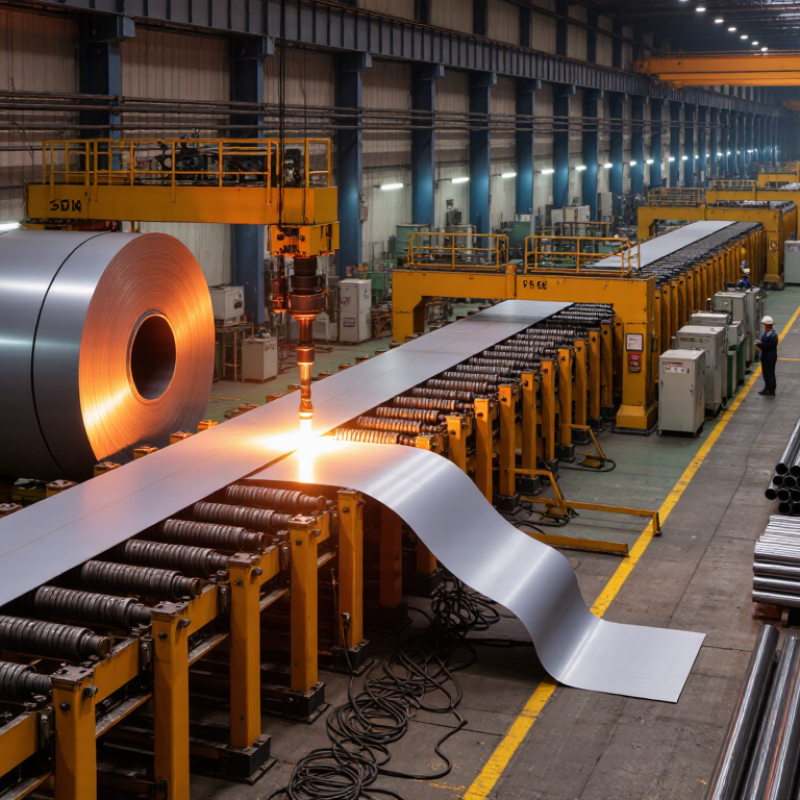
| 1. Material selection | Flat steel strip, coil, or plate is selected according to the required pipe grade, dimensions, and service conditions. | Carbon steel, stainless steel, and other specified steel grades may be used. | Material identification, chemical composition, mechanical properties, and surface condition are checked against the purchase specification. |
| 2. Slitting or plate preparation | Coil is slit to the required width, or plate edges are prepared for forming and welding. | Slitting lines, levellers, edge milling, or edge bevelling, depending on the product and process. | Width, thickness, edge condition, flatness, and material traceability are verified. |
| 3. Forming | The flat material is shaped into a cylindrical or near-cylindrical form so its edges meet along a longitudinal seam or a spiral seam. | Roll-forming stands are commonly used for strip and coil. Large-diameter pipe may be formed from plate using press or roll-forming methods. | Formed diameter, roundness, edge alignment, and fit-up are monitored. |
| 4. Seam welding | The adjoining edges are joined to create the pipe wall. The weld seam runs along the pipe or follows a spiral path, depending on the manufacturing route. | Electric resistance welding (ERW) uses electrical heat and pressure to join edges. Submerged arc welding (SAW) uses an arc beneath a layer of granular flux and may be applied to the inside, outside, or both sides of a seam. | Welding parameters and seam condition are controlled. Inspection may include visual examination and specified non-destructive testing. |
| 5. Sizing and straightening | The welded pipe is brought closer to its required outside diameter, shape, and straightness. | Sizing rolls, straightening equipment, and, where specified, expansion processes. | Outside diameter, ovality, wall thickness, and straightness are measured against the applicable specification. |
| 6. Seam treatment and heat treatment | Weld reinforcement may be trimmed or conditioned. Heat treatment may be used when required by the product specification or manufacturing process. | Mechanical trimming or grinding; controlled heat-treatment equipment where specified. | Seam profile, surface condition, and required heat-treatment records or properties are checked. |
| 7. Cutting and end finishing | Pipe is cut to ordered lengths, and the ends are prepared for handling or connection. | Saw or thermal cutting; end facing or beveling when required. | Length, end squareness, bevel dimensions, and end condition are inspected. |
| 8. Final inspection and protection | Finished pipe is inspected, identified, and protected for storage and transport. | Inspection and testing are selected according to the applicable product standard, order, and service requirements. | Checks may include visual inspection, dimensional measurement, weld examination, hydrostatic testing, marking, and coating inspection when specified. |


 Your message must be between 20-3,000 characters!